Structure and composition
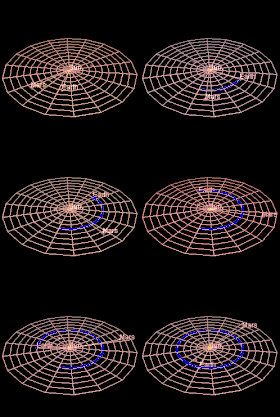
The principal component of the Solar System is the Sun, a G2 main-sequence star that contains 99.86% of the system's known mass and dominates it gravitationally. The Sun's four largest orbiting bodies, the giant planets, account for 99% of the remaining mass, with Jupiter and Saturn together comprising more than 90%. The remaining objects of the Solar System (including the four terrestrial planets, the dwarf planets, moons, asteroids, and comets) together comprise less than 0.002% of the Solar System's total mass.g
Most large objects in orbit around the Sun lie near the plane of Earth's orbit, known as the ecliptic. The planets are very close to the ecliptic, whereas comets and Kuiper belt objects are frequently at significantly greater angles to it. As a result of the formation of the Solar System, planets (and most other objects) orbit the Sun in the same direction that the Sun is rotating (counter-clockwise, as viewed from above Earth's north pole). There are exceptions, such as Halley's Comet. Most of the larger moons orbit their planets in this prograde direction (with Triton being the largest retrograde exception) and most larger objects rotate themselves in the same direction (with Venus being a notable retrograde exception).
The overall structure of the charted regions of the Solar System consists of the Sun, four relatively small inner planets surrounded by a belt of mostly rocky asteroids, and four giant planets surrounded by the Kuiper belt of mostly icy objects. Astronomers sometimes informally divide this structure into separate regions. The inner Solar System includes the four terrestrial planets and the asteroid belt. The outer Solar System is beyond the asteroids, including the four giant planets. Since the discovery of the Kuiper belt, the outermost parts of the Solar System are considered a distinct region consisting of the objects beyond Neptune.
Most of the planets in the Solar System have secondary systems of their own, being orbited by planetary objects called natural satellites, or moons (two of which, Titan and Ganymede, are larger than the planet Mercury), and, in the case of the four giant planets, by planetary rings, thin bands of tiny particles that orbit them in unison. Most of the largest natural satellites are in synchronous rotation, with one face permanently turned toward their parent.
Kepler's laws of planetary motion describe the orbits of objects about the Sun. Following Kepler's laws, each object travels along an ellipse with the Sun at one focus. Objects closer to the Sun (with smaller semi-major axes) travel more quickly because they are more affected by the Sun's gravity. On an elliptical orbit, a body's distance from the Sun varies over the course of its year. A body's closest approach to the Sun is called its perihelion, whereas its most distant point from the Sun is called its aphelion. The orbits of the planets are nearly circular, but many comets, asteroids, and Kuiper belt objects follow highly elliptical orbits. The positions of the bodies in the Solar System can be predicted using numerical models.
Although the Sun dominates the system by mass, it accounts for only about 2% of the angular momentum. The planets, dominated by Jupiter, account for most of the rest of the angular momentum due to the combination of their mass, orbit, and distance from the Sun, with a possibly significant contribution from comets.
The Sun, which comprises nearly all the matter in the Solar System, is composed of roughly 98% hydrogen and helium. Jupiter and Saturn, which comprise nearly all the remaining matter, are also primarily composed of hydrogen and helium. A composition gradient exists in the Solar System, created by heat and light pressure from the Sun; those objects closer to the Sun, which are more affected by heat and light pressure, are composed of elements with high melting points. Objects farther from the Sun are composed largely of materials with lower melting points. The boundary in the Solar System beyond which those volatile substances could condense is known as the frost line, and it lies at roughly 5 AU from the Sun.
The objects of the inner Solar System are composed mostly of rock, the collective name for compounds with high melting points, such as silicates, iron or nickel, that remained solid under almost all conditions in the protoplanetary nebula. Jupiter and Saturn are composed mainly of gases, the astronomical term for materials with extremely low melting points and high vapour pressure, such as hydrogen, helium, and neon, which were always in the gaseous phase in the nebula. Ices, like water, methane, ammonia, hydrogen sulfide, and carbon dioxide, have melting points up to a few hundred kelvins. They can be found as ices, liquids, or gases in various places in the Solar System, whereas in the nebula they were either in the solid or gaseous phase. Icy substances comprise the majority of the satellites of the giant planets, as well as most of Uranus and Neptune (the so-called "ice giants") and the numerous small objects that lie beyond Neptune's orbit. Together, gases and ices are referred to as volatiles.
Distances and scales
The distance from Earth to the Sun is 1 astronomical unit AU (150,000,000 km; 93,000,000 mi). For comparison, the radius of the Sun is 0.0047 AU (700,000 km). Thus, the Sun occupies 0.00001% (10−5 %) of the volume of a sphere with a radius the size of Earth's orbit, whereas Earth's volume is roughly one millionth (10−6) that of the Sun. Jupiter, the largest planet, is 5.2 astronomical units (780,000,000 km) from the Sun and has a radius of 71,000 km (0.00047 AU), whereas the most distant planet, Neptune, is 30 AU (4.5×10⁹ km) from the Sun.
With a few exceptions, the farther a planet or belt is from the Sun, the larger the distance between its orbit and the orbit of the next nearer object to the Sun. For example, Venus is approximately 0.33 AU farther out from the Sun than Mercury, whereas Saturn is 4.3 AU out from Jupiter, and Neptune lies 10.5 AU out from Uranus. Attempts have been made to determine a relationship between these orbital distances (for example, the Titius–Bode law), but no such theory has been accepted. The images at the beginning of this section show the orbits of the various constituents of the Solar System on different scales.
Some Solar System models attempt to convey the relative scales involved in the Solar System on human terms. Some are small in scale (and may be mechanical—called orreries)—whereas others extend across cities or regional areas. The largest such scale model, the Sweden Solar System, uses the 110-metre (361 ft) Ericsson Globe in Stockholm as its substitute Sun, and, following the scale, Jupiter is a 7.5-metre (25-foot) sphere at Stockholm Arlanda Airport, 40 km (25 mi) away, whereas the farthest current object, Sedna, is a 10 cm (4 in) sphere in Luleå, 912 km (567 mi) away.
If the Sun–Neptune distance is scaled to 100 metres, then the Sun would be about 3 cm in diameter (roughly two-thirds the diameter of a golf ball), the giant planets would be all smaller than about 3 mm, and Earth's diameter along with that of the other terrestrial planets would be smaller than a flea (0.3 mm) at this scale.


Comments
Post a Comment